Mechanics of Hierarchical Architecture
Current Projects:- Machine-Learning Designed Nanoarchitected Materials
- Dynamic Energy Absorption of Nanoarchitected Composites
- Extreme Environment Mechanics of Nanoarchitected Metals Produced via Interference Lithography
Machine-Learning Designed Nanoarchitected Materials
Personnel: Dr. Peter Serles (Postdoctoral Scholar)
Nanoarchitected materials have achieved the highest known mechanical performance across a variety of metrics such as strength-to-weight ratio or ballistic energy absorption by combining 1. Nanoscale materials which unlock unique properties like the "smaller is stronger" size effect, 2. Complex shaping of material, typically through nanoscale additive manufacturing, into mechanically efficient geometries, and 3. High performance constituent materials.
The next frontier in nanoarchitected materials for mechanical performance is exploring their design beyond typical geometries like lattices or triply periodic minimal surfaces, into non-intuitive mechanically efficient shapes designed by machine learning (ML). ML-informed design takes advantage of mechanically relevant training data to predict optimal geometries for a range of outcomes. Taking advantage of next-generation ML algorithms including hyperparameter tuning via Bayesian Optimization and generative AI topology optimization, we design unique geometries which can further amplify the mechanical response of nanoarchitected materials through efficient material distribution, stress concentration reinforcement, and buckling reinforcement. This addresses key material-driven needs for fuel efficiency of aircraft and cars, shielding for spacecraft and ballistics, and dielectric properties for electronics.
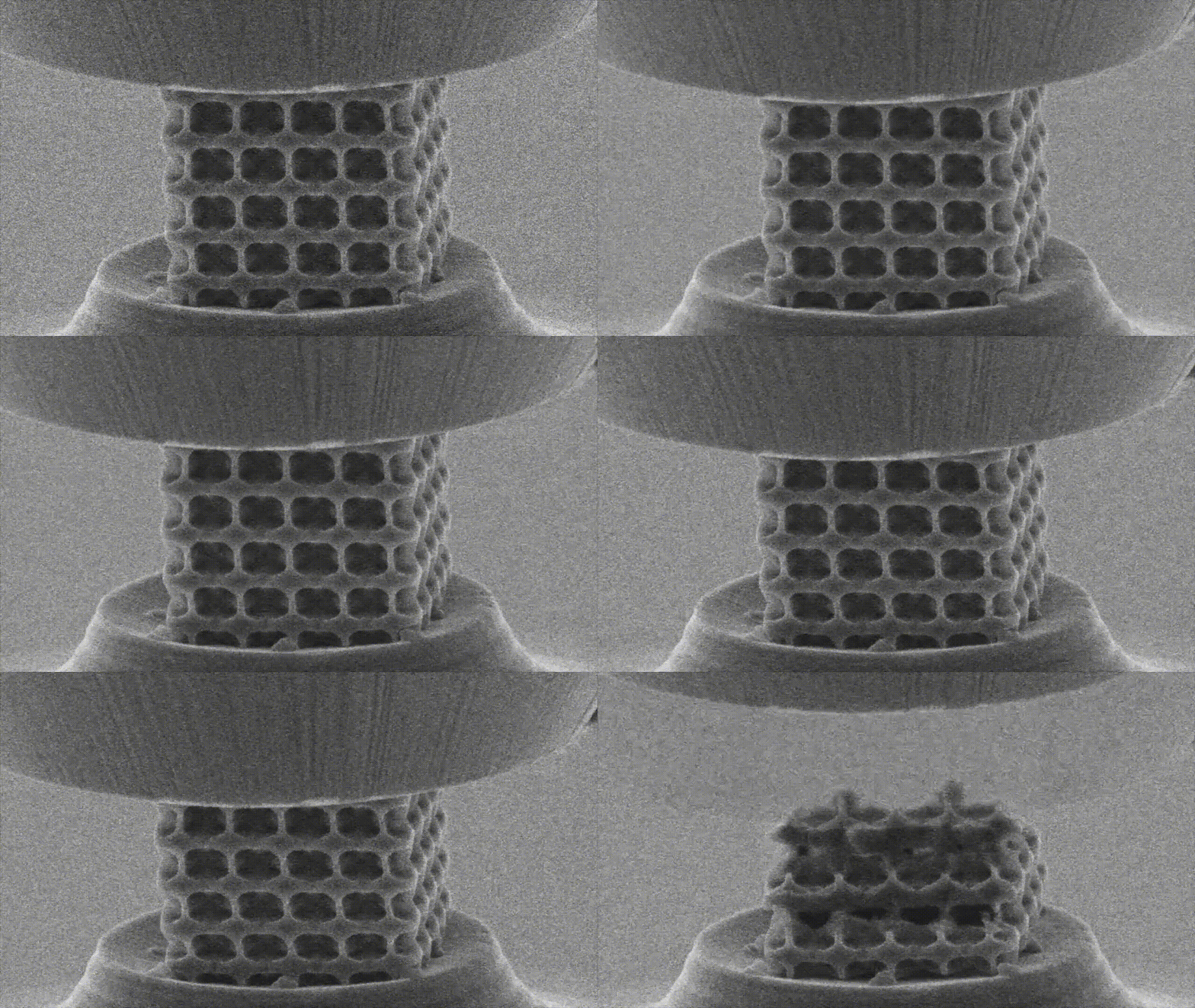
In Situ Compression of Hybrid-TPMS Structures designed by Generative AI in collaboration with the Laboratory for AI-Powered Modelling in Mechanics, Materials, and Manufacturing at KAIST.
Dynamic Energy Absorption of Nanoarchitected Composites
Personnel: Kevin Nakahara (Ph.D. student in Mechanical Engineering)
Collaboration with Professor Matias Kagias (Lund University).

Across industries from aerospace to packaging, dynamic impact events drive the demand for engineering materials, like composites, that are lightweight and have superior energy dissipation capabilities. Advanced additive manufacturing (AM) techniques, like holographic lithography, allow us to control composite material features with nanoscale resolution. Leveraging AM technologies to meet this need, we have developed a scalable approach for fabricating hierarchical nanoarchitected polymer interpenetrated phase composites at a macroscale. Samples are fabricated by infiltrating bare nanolattices, produced via metasurface-enabled laser interference lithography (LIL) [2], with a secondary epoxy system. Underlying composite nanoarchitectures are characterized via nano-computed tomography (nanoCT) and cross-sectional scanning electron beam microscopy (SEM) showing a pillar-plate lattice fully interpenetrated by secondary epoxy. These nanolattices are patterned into planar sheets and laid up vertically to create a macroscale polymer composite cube with 4mm side lengths. Dynamic compression testing of these composites in a split-Hopkinson pressure bar apparatus reveals tortuous failure, induced by nanoarchitected regions, as a powerful mechanism for energy absorption - increasing yield and plateau stress without decreasing failure strain. Nanoarchitectures present a novel approach towards maximizing energy absorption in composites under dynamic loading without the need for dense reinforcement materials..
Relevant Publications:
[1] Nakahara, K., Kagias, M., Lawlor, B., Greer, J.R. Submitted
[2] Kagias, M., Lee, S., Friedman, A. C., Zheng, T., Veysset, D., Faraon, A., & Greer, J. R. (2023). Metasurface-enabled holographic lithography for impact-absorbing nanoarchitected sheets. Advanced Materials, 35(13), 2209153.
Extreme Environment Mechanics of Nanoarchitected Metals Produced via Interference Lithography
Personnel: Ingrid Shan (Ph.D. student in Mechanical Engineering)
Collaboration with NASA Langley Research Center and Professor Andrei Faraon's group (Caltech).

Nanoarchitected metals are an emerging class of mechanical metamaterials with superior strength to weight and stiffness to weight ratios due to an efficient combination of constitutive material properties and geometric design. Additionally, ductility in metals allows for densification, a deformation mechanism in architected materials beneficial for energy absorption. Metals also exhibit the "smaller is stronger" size effect due to dislocation starvation in high surface area to volume ratio structures, but this has yet to be studied at the bulk (cm-scale) level due to manufacturing limitations. Developments in additive manufacturing have enabled complex geometries with nanoscale resolution in metals but have yet to realize these feature sizes at large volumes. We produce bulk nano-architected (<500 nm feature size) metallic impact absorbing metamaterials utilizing a rapid, high-throughput visible light interference lithography (LIL) technique combined with resin precursor design and thermal post-processing. We study the effect of process, metal composition and microstructure, and architecture on bulk mechanical properties at high strain rates in extreme environments. The fabricated samples are then tested for local mechanical properties via in-situ nanoindentation, fatigue resistance at the bulk level in extreme thermal cycling conditions, and energy absorption using both laser-induced projectile impact testing (LIPIT) and a custom impact setup.
Relevant Publications:
[1] Kagias, M., Lee, S., Friedman, A. C., Zheng, T., Veysset, D., Faraon, A., & Greer, J. R. (2023). Metasurface-enabled holographic lithography for impact-absorbing nanoarchitected sheets. Advanced Materials, 35(13), 2209153.
[2] T. A. Schaedler, A. J. Jacobsen, A. Torrents, A. E. Sorensen, J. Lian, J. R. Greer, L. Valdevit, and W. B. Carter (2011). Ultralight Metallic Microlattices. Science 334, 962-965.